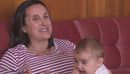
Samantha Pearson, attachment parenting, with the kids.
A preschooler feeding from his or her mother's breast can raise an eyebrow or two. But those who adopt attachment-parenting techniques, such as extended breastfeeding, communal sleeping and "wearing" their babies, are adamant there are benefits for the whole family.
Ivy is pushing her nose up against her mother's green T-shirt. "Mamma's milk, Mamma's milk," she says. After a little negotiation, Michele Walker lifts up her T-shirt to reveal a pert, braless breast. Ivy clambers onto her mother, sweeps her long blonde hair out of the way, lies back, takes a hold of the breast and begins to breastfeed, giggling all the time. Her long legs dangle down over her mother's lap, which is not surprising given that Ivy turned four in March.
"I never thought that I would be breastfeeding for so long," says Walker, who smiles as Ivy jumps off her after a couple of minutes to go and play with her vast dinosaur collection. "Or that Ivy would be one of the oldest breastfed children in Australia."
According to the Australian Bureau of Statistics, Ivy is indeed an unusual case. Figures from 2001 show that at six months, 48 per cent of babies were breastfed. By the time they reached one year, that had dropped to 23 per cent and when a child turned two - the last year monitored - only one in 100 were still having breast milk.
Walker, a 35-year-old naturopath, says she didn't consciously plan to practise "extended breastfeeding", although she was aware of clinical evidence showing it protected children against illnesses such as ear infection and some respiratory problems, as well as guarding women against osteoporosis and some forms of breast cancer. In Walker's case, like all her parenting decisions, the decision to keep feeding was based on instinct. "I am not following a philosophy," she says. "I'm just doing what feels right to me."
It also felt right to bring Ivy and her other daughter, nine-month-old Mia - who was born at home - into the family bed. The bedroom is filled with a row of mattresses and is the centre of life in the Walkers' home in Bowen Mountain, west of Sydney. Night in, night out, the two girls doss down with Walker and her partner of 11 years, Lloyd Weir. "We sleep together for ease of breastfeeding and we can comfort the children if they wake up," says Walker. "Ivy puts on dancing and acting shows before we get into bed. It's a fun place to be. No one has gone to bed crying in our house, ever."
It was only when Walker began investigating her parenting choices that she discovered she slotted into a style of parenting called attachment or continuum parenting. Although there is no clinical definition, it is characterised by parents noticing and focusing on children's needs - physical and emotional - and responding immediately. Attachment-parenting proponents often sleep with their children, breastfeed them until the children are toddlers and "wear" them in slings or on their hips as often as possible.
Statistics are not available on the number of Australian families who follow the attachment-parenting model. However, research suggests many of them have been inspired by American anthropologist Jean Liedloff, who wrote The Continuum Concept: In Search Of Happiness Lost in 1975, after spending over two years observing Yequana Indians in South America. According to Liedloff, the Yequana children - who slept with their parents, were continually carried in their parents' arms in the early months and were breastfed until they wanted to wean - rarely fought and lived in a very harmonious society.
While opponents of attachment parenting dismiss it as overindulgent and over the top, Walker has no regrets about her parenting style. "Ivy is kind, caring, confident and independent. We are a happy family and I am happy we have made the right choices."
That's not to say there aren't challenges. Feeding in public, for example, became a trial once Ivy became a toddler. "I felt the looks," says Walker. "But then, when I fed, I used to connect with her and stop noticing anyone else. There were times when I thought, 'Bring it on. If you want to challenge me, come on', but other days, I preferred to go to the breastfeeding room or the car."
Opinions grew louder when she became pregnant with Mia and continued breastfeeding Ivy. "People were shocked," she says. While Weir, 35, who is an art director in a multimedia company, fully supported her, others questioned her methods. "Some of my family asked me if it would harm the baby in the womb. I had to explain it was fine."
Daily life for the family is flexible, with no routine.
"If Ivy feels like she wants to do playdough and doesn't want to stop for lunch, then that's OK. As long as she is doing what makes her happy, I facilitate that. But she can't do absolutely anything. She wouldn't be allowed to draw on the walls, for example." But when Ivy wants me to move from the seat she wishes to sit in, Walker gives a slightly embarrassed laugh and asks that I make way. "Children rule my house."
She's not wrong. Walker, who is postponing returning to work until the children are older, never uses a babysitter and refuses to leave Mia even for an hour because she could need to feed at any time. "I am human and there are times when it is hard," she says. "But I consider this to be a tiny portion of my life and a massive part of theirs. I believe they will have high self-esteem and confidence and feel they have family they can rely on. I also believe they will be able to communicate properly and express their emotions and be intelligent and confident enough to make good choices in their lives."
But, asks Christie Mellor, author of We Were Here First, Kid!, "by letting your kids 'rule the house', what kind of message are you giving them? They are not learning co-operation, sharing, kindness or empathy but arrogance and a false sense of entitlement. When you finally unleash your child into an unsuspecting world, will the world gain an adult who knows how to work as part of a team?"
Some parents following the attachment model find themselves exhausted by its demands, says Ann Hindell, parenting services manager of Tweddle Child & Family Health Service in Melbourne's Footscray. The centre offers residential support for parents struggling with their parenting and has a strong focus of settling, sleep and routines. Hindell has seen clients worn down by years of sleeping together and breastfeeding day and night. In one case, a child who was always breastfed to sleep, which is common in many attachment families, was very clingy and the mother needed time away. "If the child associates going to sleep with breastfeeding, how does the child develop independence?" asks Hindell.
For mother-of-three Samantha Pearson, the answer is "when the child is ready". Pearson's own upbringing was traditional and at first she followed a similar route. When her son, Jordan, was born 14 years ago, she placed him in a cot (she now refers to it as a "cage") and gave up breastfeeding at six months, on the advice of a doctor. It's a decision she has always regretted. "I did it cold turkey," says Pearson, 40, who reared Jordan on her own after she separated from her partner when Jordan was a baby. "He screamed and I wept. It was very traumatic."
Pearson now has two daughters - Leilu, 4, and Aalia, 16 months - with Nick Nelson, her partner of 13 years, who is an arborist and a product of attachment parenting himself. Together, they implemented the principles. Leilu was breastfed until she was well over three. They allow the child to decide when to wean and also when they are ready to leave the family bed. Jordan was home-schooled until 11 and the parents use gentle discipline with few rules. "There is no smacking, no belittling, no shaming, no shouting," says Pearson, who was a massage therapist before she began home-schooling. "We explain feelings and how actions make others feel."
Attachment parenting is often described as a hippie throwback. Pearson, who runs her own baby-sling-making business from home, laughs at the idea, although she confesses to owning a kaftan and that she used to wear a toga. "Sometimes I forget how out of the mainstream I am. I see a small baby being fed a bottle and I feel shocked. Then I realise how alternative I have become."
Parenting choices are personal choices, she says - "You've got to do what suits your family and what suits you" - but she knows there's no way she could drop her children at a child care centre and happily head off to work. "I see long day care as unhealthy for the relationship between parents and children.
I understand there are pressures from society to have material things and to find fulfilment through work but I find other ways to find that fulfilment."
She acknowledges that not too many parents feel the way she does. To demonstrate, she walks over to the bookcase and reaches above the puzzles and jigsaws to bring down a piece of muslin. She unwraps it, revealing Aalia's dried crumbly placenta with the cord attached. "I would like to do something with Aalia, like plant it under a tree because it nourished her before she was born and I have the feeling it should be respected."
Meanwhile, Aalia is clambering over her mother and delving under her shirt for "nannas", the name she recognises for her mother's breasts. The benefits of breastfeeding don't just suit the child, says Pearson. "When you breastfeed, you are rewarded with hormones. Breastfeeding on a regular basis keeps you calm. The cleaning, washing, cooking and housework can be repetitive but breastfeeding helps you be a better mother."
Extended breastfeeding - or even feeding after six months - hits a nerve in our society, says Wendy Burge, president of the Australian Breastfeeding Association and an advocate of breastfeeding "for as long as the mother and child desire". She says our attitude to breastfeeding older children is a problem as the World Health Organisation recommends that breast milk should remain a component of a child's diet until they turn two or beyond. "It is debated how much benefit there is after the age of two but we believe there is a continued benefit," says Burge. "The longer you feed, the greater protection there is from diseases such as diabetes, obesity and gastric illness. And it is a lifelong benefit."
According to Burge, in Australia there is a cultural understanding that babies should be weaned early and that is partly because mothers want to be more independent. "There are pressures on our time, such as going back to work," she says.
Even the way breasts are viewed in Western society and portrayed in the media can add psychological barriers to feeding an older child. "Breastfeeding is always seen as a sexual thing as well as a nutritional process," she says. "And I don't think we will ever get away from that."
Years of breastfeeding, co-sleeping and constantly carrying your baby appear to leave little space for the needs of the parents. But, says Pearson's partner, Nelson, 30, that is a misconception. "I would guess the divorce rates are lower among attached families because it supports the sanctity of the family unit."
Attachment parenting can be demanding, he says, but "we have chosen to have children and accept that responsibility. The kids aren't going to be with us forever. I'm not going to lie and say I don't look forward to the time when they are grown up and we can go travelling and do our own thing. But selfishness and greediness have become such a big part of society in the West. It's all me, me, me."
The conflict between modern-day life and the alternative ideas of attachment parenting is something Simone Brice, 40, well understands. To help support her parenting choices, she has joined with like-minded parents and created what they call a tribe. "Instead of having a playgroup for a couple of hours, we meet in each other's homes for a whole day," explains Brice, who works as a desktop publisher at night while her partner, Robert Partridge, 36, a technical writer, cares for their highly articulate two-and-a-half-year-old son, Oscar. "We prepare food together, look after kids together." She cheerfully admits it sounds "wacky" but says it has helped her feel she is not alone in the decisions she makes.
Brice is eight months pregnant with her second child and plans to add the new arrival to the family bed. "We will all be together, the whole family, and there couldn't be a better or more pleasant way of all four of us bonding." (On the subject of intimacy, "The family bed is not where we have sex," she says with a laugh, "but the rest of the house is looking good!")
Brice is undeterred by health professionals who argue that co-sleeping is dangerous because of the risk of sudden infant death syndrome. A report last month from the Foundation for the Study of Infant Deaths in Britain found that one in four such deaths occurred in the adult bed. Researchers reported that the children had overheated, been smothered, fallen out or stopped breathing for no apparent reason.
Brice believes you can take precautions to make it safe, such as never co-sleeping when under the influence of drink or drugs and using blankets, not doonas, to avoid overheating and smothering. "If they are in another room, you're not aware if they stop breathing but if something happens in the bed, your mummy alert goes off and you can do something."
As well as sleeping with her until the child is ready to leave, her new baby will also be breastfed for as long as he or she chooses. "I know it has been good for Oscar - he is so healthy. His immune system is very robust. His speech is exceptional for his age and that is because breastfeeding develops the palate."
As a style of parenting, it sounds exhausting. True, the children are less clingy than one would expect and there is a sense of calm in the homes of Walker, Pearson and Brice but from the outside, it is difficult to see the pay-off for the parents. "There are times when I do wonder if I am crazy," says Michele Walker. "But the other day, Ivy was jumping up and down and kissing me and Mia and she said, 'I am so full of joy.' Then I knew I was doing the right thing."
Discuss this topic in the breastfeeding forum.