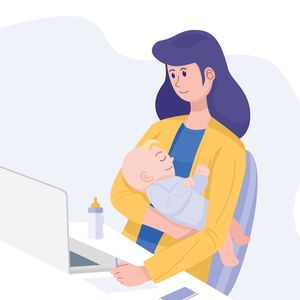
Working mums.
Western women are twice as likely to suffer depression now than they were 40 years ago, because they’re pushing themselves so hard to care for their families and have active careers, says a recently published study of European women.
The German study found a steep increase in female depression since women started entering the workforce in droves back in the 1970s and claimed the "strain of trying to cope with having a family and pursuing a career is leaving women with a tremendous burden".
In a similar vein, a Washington University study of 1600 women found that "Supermums," those who juggle demanding careers and families, were also far more likely to be depressed than women who "simply accept they cannot have it all". Those women were defined as those who let go of their career aspirations and chose less demanding jobs, accepting that compromise is necessary when you’re a mother.
I have to admit, I feel quite torn about the implications of these findings. While I can certainly relate to the pressure and do feel overwhelmed and exhausted myself lately, as I attempt to ‘do it all,’ I wouldn’t have expected the rates of depression to be so much higher for that group. I would have predicted the isolation and relentlessness of stay at home mothering would contribute to just as many causes of depression.
The idea of the ‘Supermum’ has been in the media a lot lately, with the release of the movie ‘I Don’t Know How She Does It,’ starring Sarah Jessica Parker. I read the book it’s based on many years ago and loved it, even though I was not a working mother myself at the time. I have no doubt I will relate to it even more now and am looking forward to seeing the movie.
However, I’m not a fan of the term ‘Supermum.’ It implies there’s something extraordinary about being a working mother who’s trying to juggle it all, when the truth is, most women these days don’t have a choice on whether or not they juggle it all. If you’re a mum and you want to work, or you have to work, what other choice do you have?
I also feel the term feeds into that tired old battle of ‘who works harder’, the working mum or the stay at home, when we’re all just doing the best job we can with the situation we find ourselves in.
I have found it interesting to note the differences in experience with my own children, with my work situation quite different from one to the other. With my first I didn’t work at all for the first year, my world was entirely focused around him. We went on walks, went to playgroup, had coffee mornings with my mothers group, visited the library and spent uninterrupted quality time together. I absolutely loved it and, aside from neither of us sleeping much, it was a pretty relaxed time.
On the other, the first year of my daughter’s life coincided with an incredibly busy time in my career, which has involved writing from home, producing and performing in a musical, lots of gigs and even going on tour. There are no walks to feed the ducks, no leisurely visits to the library, occasional hurried trips to playgroup and a lot of checking emails on my phone while she screams to play with it.
It is undoubtedly more hurried and hectic than her brothers first year and there are days when I long for that simple time and feel I have taken on too much. But there are also moments where I feel such incredible career satisfaction, it makes all the exhausting juggling seem worth it.
And, to me, that’s what this study ignores. I have no doubt those women who return to work due to financial obligations, regardless of what they would prefer, would show higher rates of depression. Those women don’t feel like ‘Supermums,’ they just feel like they’re running from one thing to another, doing what they have to, to get by. For them ‘doing it all’ is not a feminist choice of the modern woman, it’s a matter of necessity.
And yet for some, myself included, who derive fulfillment from their careers, it is worth the exhausting effort of ‘trying to do it all’ for the benefits gained. Yes, it’s tiring, but personally I would be much more depressed if I accepted the ‘necessary compromise’ and sacrificed my own aspirations.
Either way, one thing is for sure. While modern women have proven we can do it all, attempting to do it all perfectly is another thing entirely. It is not only completely unrealistic, it is an added pressure none of us need.
I came to this conclusion a little slower than I should have, but have embraced it ever since. Which is why, as I’m writing this, my daughter is sitting on the floor feeding herself yogurt (because she is refusing the highchair) and getting it all over herself, the floor, me and her toys. And it is why the pile of ironing in the laundry is threatening to engulf me, my manicure needs doing, the backyard is a mess, the floor needs mopping and I haven’t made the beds yet. Some days I look at those things and do feel slightly depressed, but luckily I don’t have enough time to ponder on it for too long. I don’t want to accept I can’t have it all, I want to give it a red hot go. But I can accept some things will suffer and if that’s the ironing, it’s a price I’m prepared to pay.
What do you think of this study? Do you feel the pressure to be a 'Supermum' and 'do it all' is too much? How have you worked out a balance in your life and would you change your situation if you could? I'd love to hear your thoughts..... Go to Amity's Blog.
Amity Dry is a writer, composer, singer and mum of two. She blogs for Essential Baby and is the writer and composer of ‘Mother, Wife and the Complicated Life,’ a new musical that takes a raw and honest look at marriage and motherhood. Follow Amity on Twitter.