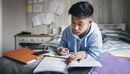
When paying pocket money, consider giving a combination of notes and coins to help familiarise children with different denominations.
Sound financial habits should be taught from a very young age, writes Bina Brown.
You only have to look at Australians' high level of individual debt and low savings rate to see that good spending and savings habits don't just happen, they are learnt.
The Commonwealth Bank of Australia's head of school banking, Lisa Cartwright, says it is never too early to learn the value of money and how to budget and save. In fact, she says, the earlier you teach children about saving versus spending, the better prepared they will be to manage their own money.
Cartwright, a former primary school teacher, says that because saving must be learnt it is important to reinforce positive behaviour and positive outcomes.
If you set children a goal of saving money then they should be rewarded once their goal is reached. It may be that they get to spend some or all of the money.
The difference between needs, wants and wishes is also something that is learnt. If children grasp this concept early then they should be better prepared for making good spending decisions down the track.
You should start teaching children about money as soon as they can count confidently, Cartwright says.
"Introduce them to the concept of money and how we count coins and notes," she says. "Take an active role in providing them with information. Observation and repetition are two important ways kids learn."
POCKET MONEY
Getting paid for jobs around the house is a good way to teach children about the value of money. Rewarding them for regular jobs and giving them the opportunity to earn more by doing extra tasks could be a good approach.
How much you give depends entirely on the family budget. What you get children to do will depend on their age.
Research by Bankwest found that about half of parents surveyed for their Raiding the Piggy Bank report gave their children pocket money, with the average amount $10.68 a week. NSW kids were the country's best paid at $12.40 a week, compared with $8.70 a week for their South Australian counterparts.
Nearly three out of four parents set conditions for pocket money - the most common being performing chores around the house, followed by good behaviour and good school performance.
Household chores included tidying their room, making their bed, cleaning the kitchen, feeding pets, folding washing, vacuuming or sweeping floors and washing the car.
While the Raiding the Piggy Bank report highlights these and other positive pocket-money trends, it also reveals that parents are increasingly turning to their children as lender of last resort. Encouragingly, most parents say they pay back the money they purloin from their children's savings.
Cartwright says when paying pocket money, consider giving a combination of notes and coins to help familiarise children with different denominations and how to allocate money. It is also wise to encourage them to divide portions of their money for spending and saving, she says.
OPENING A BANK ACCOUNT
The value of saving is best learnt by opening savings accounts where children are encouraged to deposit a portion of their pocket money on a regular basis.
Bankwest's head of deposits, Juan Perez, says it is important to open an account with a child and to make it as exciting as possible.
"Make it an outing," he says. "Tell them they are such a big boy or girl now they are going to open their own account."
Perez says saving money has to be a positive experience. Remember that at age five or six, money is something children are going to want to use.
The concept of saving and earning interest might come down the track.
The Commonwealth Bank's school banking program has primary school children open an account at school, with children making regular deposits to their account while they are at school.
This year, the CBA launched a new rewards program that encourages children to save money regularly.
Participating schools receive commission from school banking deposits and new accounts, a source of additional funding for school initiatives.
TIPS FOR SAVING
Make a wish list and set goals. If there's something your child really wants, sit down with him or her to work out exactly how much it is going to cost, followed by what the child must do to buy it - a savings plan.
Make the savings journey visual. Stick a picture of the desired item in the child's room to help visualise the goal.
Set a good example and save money in front of your child. Keep your own money box, or deposit money in the bank when you are with your child.
Source: The Sun Herald
See more saving tips in our Managing Money forum.